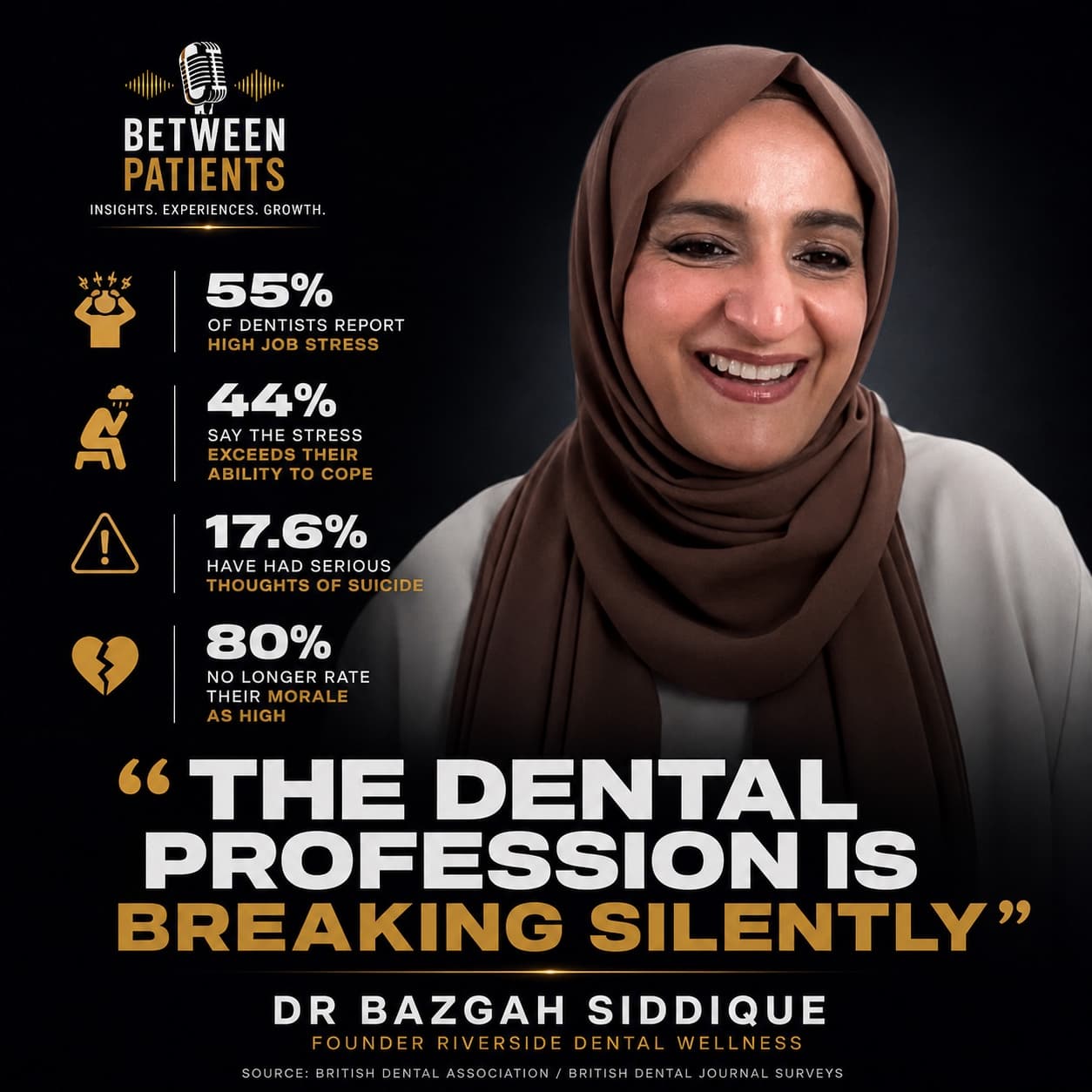
Burnout in Dentistry — What It Really Looks Like
You know the feeling. You've been up since 5:30. The surgery's been full since 8. It's 5 PM and you still have three more patients, your schedule's overbooked by forty minutes, and your hygienist just told you someone's emergency crown isn't fitting right. The pressure sits behind your eyes.
That's not burnout. That's Tuesday.
Burnout is what comes after a thousand Tuesdays, when your body stops arguing and starts shutting down.
What is burnout, actually?
Burnout is not stress. Stress is a response to pressure; burnout is what happens when the pressure doesn't stop and you stop believing it ever will.
The medical definition is simple: emotional exhaustion, depersonalisation, and reduced personal accomplishment. In dentistry, it looks like this:
- You stop caring about doing the best clinical work. You just want to get through the day.
- You feel cynical about patients. They become problems instead of people.
- Your confidence in your ability to do the job starts to crack.
- You go home and have nothing left. No energy for your family. No energy for anything.
That's different from being tired. Tired is fixed by a weekend. Burnout is fixed by changing something fundamental.
Why dentists get burned out
Three reasons. The first is obvious: the work is hard. You're responsible for people's health and they're often scared or in pain or both. That's emotionally taxing.
The second is less obvious: you own the problem. Whether you own the practice or you're an associate, you own the outcome. The patient goes bad, the filling fails, the root canal flares up — it's on you. That's not true in every profession.
The third reason is the one nobody talks about: dentistry rewards volume, not quality. The faster you move, the more patients you see, the more money the practice makes. But the faster you move, the less you enjoy the work. So you're constantly trading the thing you got into dentistry for — the craftmanship, the problem-solving, the satisfaction of a good result — for the thing you need to pay for: the income.
Practice owners get it worse because they're also managing the business. You're not just doing dentistry. You're managing staff, dealing with complaints, worrying about payroll, navigating compliance, handling the patient you had to fire because they were abusive. By 5 PM, you're depleted three times over.
What actually helps
The short answer is: you need to change something. You can't rest your way out of burnout if the thing causing it doesn't change.
Here's what doesn't work: going on holiday. You'll feel better for a week, then come back to the same system and it'll crush you again.
Here's what does work:
Reduce patient volume. Not taking a day off. Actually reducing how many patients you see per day. Six patients instead of eight. This gives you time to do good work, time to breathe between patients, time to not feel like you're drowning.
Stop seeing emergencies. Or designate one day a week. The emergency patient is always a crisis. The crisis is always stressful. You can't control it, can't plan for it, and it wrecks your schedule. If you're burned out, stop volunteering for that stress.
Hire the right associate. Not someone cheaper. Someone you trust. Someone who takes work off your plate instead of adding to it. This is worth paying for.
Have a real system. Not a software system. A system for how your day works. When do you plan? When do you do crown starts? When do you do hygiene checks? If every day is a surprise, you'll burn out faster.
Know your walk-away number. How much do you actually need to make? Not want. Need. Because once you know that number, you can stop chasing volume and start making decisions based on sanity instead of fear.
The hardest part
The hardest part is admitting you need to change something. Because changing something means your income might drop. It means telling patients no. It means being the associate who says I'm not taking emergencies. It means being the owner who closes the schedule even though people are calling for appointments.
But the alternative is burnout. And burnout doesn't just damage you. It damages your work. Burned-out dentists make more mistakes. They're less empathetic. They burn out their staff too.
So the question isn't whether you can afford to change something. The question is whether you can afford not to.
Listen to the full conversation about this on Between Patients. We talk about what it looks like from the inside, why the profession is built this way, and what actually works when nothing else does.
Apply to be a guest — if you've been through this, your story matters.

Host, Between Patients
Host of Between Patients and the fourth generation in a dental family. I sit down with private practice owners for the conversation we usually only have once the door is closed — no script, full editorial control, a real record of how they think, decide, and rebuild.