Master One Thing, Charge More
Dr Maninder Kaur
Cosmetic Dentist & Implantologist
Wigmore Smiles & Damira Dental · Luton & Henley-on-Thames, UK
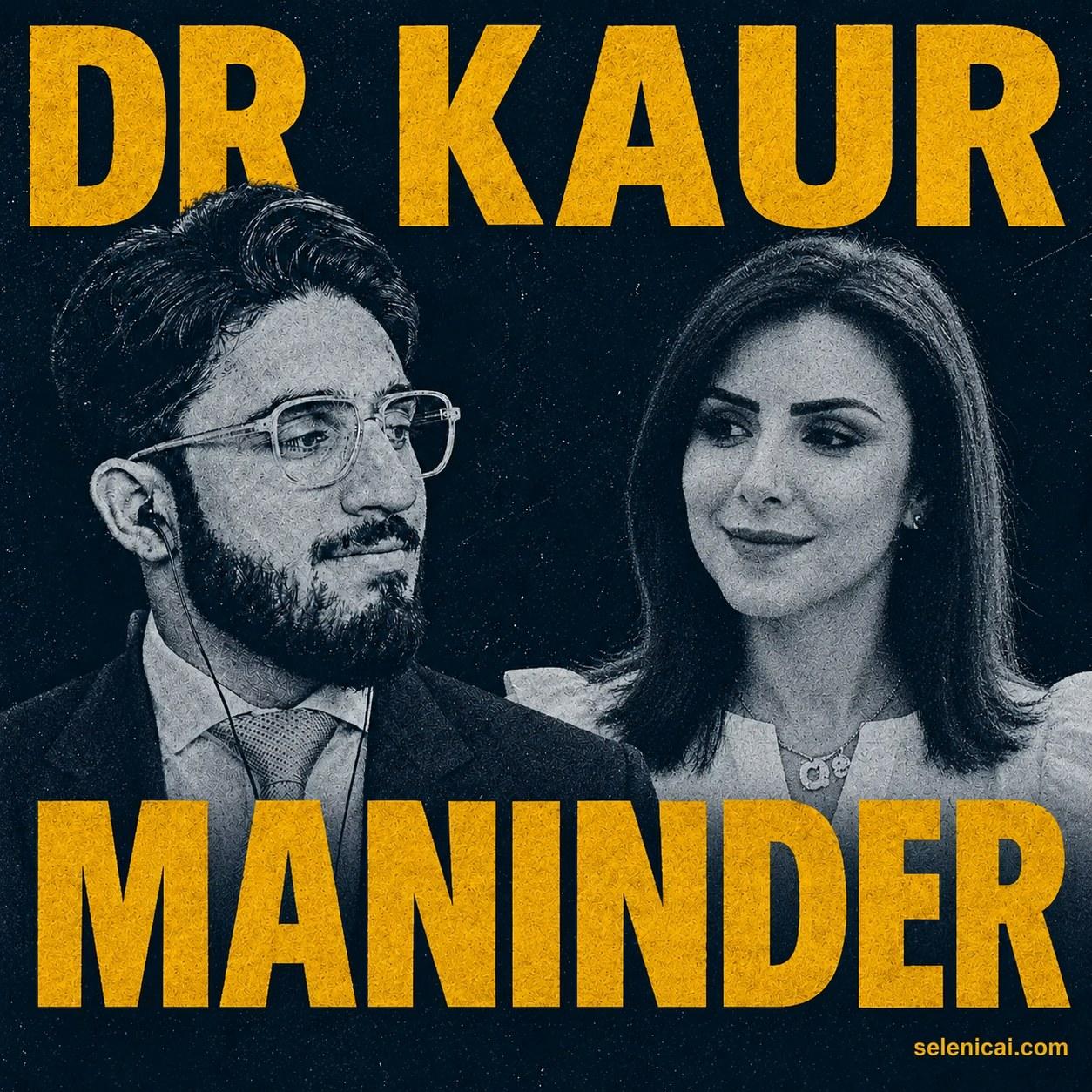
Watch the episode
About this episode
Dr Maninder Kaur wanted to be a doctor. The decision to do dentistry instead arrived days before her university interview, and she took it for a reason that had nothing to do with teeth: dentistry did not carry a twenty four hour liability. She qualified in India, where she was born and grew up, and says the course asked for things she had not expected at all.
Marriage brought her to England, and the career started again from zero. There was a gap of six or seven years between dental school and treating a patient. She sat the ORE conversion exams, took a hygienist role to fund herself, then worked a full year as a trainee dentist for no pay because that was the only way to earn a performer number. Before that she handed CVs around practice after practice, at a time when the United Kingdom was not short of dentists at all.
Ten years on she is a cosmetic dentist and implantologist across two practices, Wigmore Smiles in Luton and Damira Dental Studios in Henley on Thames, and she is honest that it is too much. Five days including every Saturday, messages from both practices on her days off, and a four day week she would prefer but has not got. In this conversation she talks about the work patients never see, how she reads a frightened patient before they say a word, the scanner that gets treatment plans accepted, what happens when work done abroad comes home, and the plan for her own practice, an MSc in implants, and teaching.
In this conversation
- Wanting to be a doctor, and changing her mind days before the interview
- A six or seven year gap between dental school and treating a patient again
- The hygienist job that funded her, and the year as a trainee dentist for no pay
- Handing CVs around practice after practice when nobody was short of dentists
- Why Brexit flipped the market, and why the exams are easier to pass now
- The work patients never see: referrals at lunch, lab calls either side of clinic, CPD at home
- Why the medical history form comes out every visit, and the medication patients forget to mention
- Reading a nervous patient: the coldness, the “I am only here for this”, and teeth that show the years away
- Five days a week including every Saturday, and why she would rather work four
- Absorbing patient anxiety all day, and de-stressing it before it burns you out
- An AI receptionist taking the bookings, and Kiroku writing her notes while she listens
- Showing a patient their own scan, and why treatment plans get accepted on the screen
- Picking up the pieces when treatment done abroad comes home
- The one change she would make: proper investment in NHS dentistry
- Jack of all trades, or master of one, and the plan for her own practice and an MSc in implants
Transcript
Lightly edited for readability. Episode 6 of Between Patients, recorded November 2026.
Welcome
Moiz: Welcome back to Between Patients. I am your host, Muhammad Moiz Khurram. Today I am joined by Dr Kaur. She is one of the cosmetic dentists at two different dental practices here in the UK, and she is based in Windsor. So today what we are going to be discussing is her perspective: what she thinks about dentistry as a cosmetic dentist, how she got started with dentistry, and where she thinks dentistry is heading in the future. Dr Kaur, welcome to Between Patients.
Dr Kaur: Absolutely. I am very happy that we finally grabbed some time to be on the podcast.
Moiz: Before we get into it, tell me more about yourself. Did you always have a thought of becoming a dentist, or what really happened that motivated you to become a dentist?
Dr Kaur: To be very honest, I wanted to be a doctor. I always wanted to. But it happened that just when I was about to do my interview, I was going to join the university, something happened. It came to my mind that I want to do dentistry. And it was a lot easier to be a dentist because there was no twenty four hour kind of liability to work as a dentist back home in India, which is where I was born and grew up.
But then when I joined, it was totally different. I was not expecting to do anatomy and all that. I wasn't expecting that. But then I started enjoying the whole process of what dentistry was about. It was not just treating diseases, it was about the cosmetic treatments and all that.
So when I did that, I came to the UK, and it took me some years to do the conversion exams. I started over again. I started at the base level with general dentistry, but over time I developed more of a compassion for cosmetic dentistry. I don't know, it was just my genes or something that was drawing me towards the line angles, everything, getting it perfect. So this is how I started doing more cosmetic dentistry, replacing missing teeth, and I kept on learning. And then here I am, doing cosmetic dentistry and implants now as well.
Leaving India
Moiz: You graduated as a dentist in India. Why did you decide you wanted to pursue the career in the UK and not in India? What made you want to move to the UK, pass the conversion exam, and become a dentist in the UK?
Dr Kaur: Sometimes it is not what we think. Destiny brings you. For me it was destiny that brought me here. I got married here, this is why I came here. It just happened that I came to England. I never thought about moving anywhere from my country, but it just happened that I met a partner who happened to be here.
Moiz: The typical process is you pass the ORE, then you become an official dentist in the UK. Do you think the ORE exam was very difficult for you, or was it something that was easy?
Dr Kaur: Back in the day it was very tough. There are many exams. You have to pass the theory exams first, then there are practical exams, and if you don't pass the theory then you cannot get to the next stage. But luckily it happened for me fairly quickly, I was lucky enough to pass. You have to work really hard, study hard, and there are finances as well that go towards it.
Dental school
Moiz: Speaking to some guests on the podcast, a couple of them had a very nice experience at dental school and learned a lot of new things. For some of them it was a whole nightmare, staying up all night memorising the text. What was your dental school life like?
Dr Kaur: It was actually a wonderful experience. When you go to university you get to live an independent life. When you live with your parents you don't know about the real world, so when you go to university you learn how to live by yourself, and then you make lots of friends. Study wise it was a good experience as well. Luckily we got very good teachers and we got many mentors there, and they were all very helpful. So I learned a lot there. It was a good journey, I would say.
The first job
Moiz: When you got your very first job after qualifying, which job was that? Did you directly become a dentist, or did you get some sort of junior role?
Dr Kaur: It was about ten plus years ago when I passed my exam. At that time there was no scarcity of dentists. There were plenty of dentists. So it was really hard, because after passing your ORE exam you have to get a position. You have to do a kind of one year training, because you don't get the performer number. You have to work under somebody, so you get a performer number after a year.
At that time it was not easy. There were not many people taking dentists for that position, because it was not funded by the government. So what I started, because I wasn't living by myself, I got into a hygienist role first. That was funding me. Then, while doing that, I got a position as a trainee dentist as well. For a year, at that time, I didn't get paid for that position, but I got the experience. I say thank you to the dentist who gave me the position.
After doing that, when I got my performer number, it was easier to get positions. But the first position was very difficult. You had to literally go and ask many people and hand your CVs out. At that time it was difficult.
Moiz: I believe it takes a lot of resilience to get your very first role. Initially it may seem almost impossible to get your first role without having any sort of performer number. But if you do enough volume, if you hand enough CVs out to people, one or two might actually contact you. The moment you get the first job and get the performer number, I believe it becomes much easier for you to grow in your career.
Dr Kaur: That's right, because you have proven yourself by that time. You have never worked in the UK before, and your degree was from abroad, even though you have done the ORE here.
Time has changed massively now. People need dentists, as many dentists left, probably because of Brexit, and many NHS dentists left to do private dentistry. So now there is a scarcity of dentists. There are so many positions available. It is so much easier to pass the exams as well now.
Studying has become much easier because of so many changes on the internet. Study material is available so much more easily now. Back in the day we could only study with study partners over the phone, or there was an app called Skype. We used to study through those video calls with each other.
AI in the practice
Moiz: I remember Skype, it was quite popular for video calls. Then WhatsApp took over, and now it is the era of AI. You want to ask any question, just use ChatGPT.
Dr Kaur: Yes, you don't even need study partners now, to be very honest. You can just chat to these AI apps and they give you all the answers you need.
Moiz: The other day I was speaking to Dr Jono, he is in Australia, and we recorded a good length of podcast on how AI and robots are going to be implemented into dentistry. If you look at the physical aspect, there are already companies producing robotic agents and machinery to do dentistry. Two hundred thousand, two hundred and fifty thousand dollars to produce that machinery, and it is a huge chunk of metal that is going to be sitting in the practice. He mentioned he wouldn't trust that machinery with his own teeth. I believe when it comes to robots there is still a long route to clear before patients can really start to trust them. But when it comes to AI, it is definitely out there. There is a very popular thing nowadays, an AI voice receptionist. Have you heard about it?
Dr Kaur: Yes, we are using one in our practices. Definitely in Wigmore Smiles in Luton where I work. I see so many bookings done by the AI receptionist, and we are already using AI in many other ways.
I use AI notes. When I am talking to the patient, I don't spend time writing notes. I use one of the AI apps, Kiroku. It helps me write down all the notes while I am talking to the patient, so I am spending more time listening to the patient and helping them, rather than diverting my mind towards writing notes. Even when I was writing notes back in the day, I couldn't be that great at writing notes, but now it records every authentic word which needs to be there. It is good for both myself and my patients.
Moiz: I believe the era we are living in, AI is not out there to replace humans, but what it can really do is make humans more productive. One thing is for sure, when it comes to decision making, one suggestion to everyone who is listening: never use AI for your decision making. If you solely become dependent on AI, it is a nightmare.
What that first year taught her
Moiz: You got your very first job, you got your performer number. What exactly did that teach you in that specific year?
Dr Kaur: That year was to learn the basics, how to treat. There was a gap of about six, seven years in my dentistry. Even though I never forgot what dentistry was, it was in my genes. Whatever I learned at university level always stayed in my mind.
So I learned the basic things: how to treat, what the protocols are here, what the NHS protocols are to follow, how the NHS BSA works. Those are the things you need to learn from your first job, because back home it is just basic private dentistry, there is nothing like the NHS BSA. Here in England there are many regulatory bodies, so you need to learn how to work with them. That is what I learned from a mentor. And band one, band two, band three, how to charge, what is included in these, and things like that.
The work patients never see
Moiz: What is the part of your work that patients never see?
Dr Kaur: They don't see how much background preparation goes into the work. They don't see how much effort we put into making sure that their treatment is going well.
For example, in the NHS, when you see patients and they need referrals, we sit behind maybe on our lunchtime, or maybe after work, making sure we are doing their notes properly, so that any time they are seen in future there is a record of it. We make sure their medical history is there. When they come into the practice we give them a medical history form by the receptionist, and many people ask the question, why are you giving us this, we just did it, why are you asking us to do the medical history again. But very importantly, medical history can change any minute. Sometimes patients don't think about a single medication they have just started taking, and that could make a lot of difference, it could interfere with the treatment. So we go through all the medical history, making sure their treatment is going well, where their health interest comes first.
When we are doing referrals, making sure we have all the information gathered so we can refer them, that takes a lot of time. And the cosmetic treatment, when we do Invisalign and all that, we make sure the treatment planning is done correctly and it has been sent on time. This is not done when they are there, this is done around them. And implants, there is so much implant treatment planning going on in the background, and dealing with the labs. When patients get veneers done or composite bonding done, there is so much designing. We talk to our labs, and so many times we call them early in the morning, or at the end of the day, or while we are eating our lunches.
And not just these, we do CPD, we keep studying all the time, making sure our knowledge is up to date, that we know what the new protocols are. So the patients don't know about this, and most of our time goes in there.
Moiz: It is not just the surgery, not just cleaning the teeth, there is a huge amount of prep that is actually required before that.
Dr Kaur: Yes.
Nervous patients
Moiz: Let's talk about patients and communication. Patients who come into the dental practice always have this instinct that they hate dentists. In one way or another, explicitly or implicitly, they either tell the dentist or they never tell. If you were to deal with patients who say I hate dentists, how do you deal with that? What communication patterns or frameworks do you follow?
Dr Kaur: As an experienced dentist I ask them. You can assess it. As soon as they walk in, either they will tell us anyway, or if they won't tell us we would know by their body language, or they will refrain from a few things.
So what I do is I like to have a conversation with them. What are their anxieties about dental treatment, or they will tell me about their past history anyway. Then they start opening up, and they tell us if they had past experiences, this is why they are a bit anxious about it, or they just generally don't like coming to the dentist. So we start talking about it one by one, and then we try to refrain from using the things they don't like, and we talk around how we can help them. Once they feel comfortable, there are many times I have seen they are happy to go ahead with the treatment. And so many times they don't even want to change the dentist any more.
Moiz: For young dentists listening to this podcast, what are the patterns you typically see in their body language? What tells you this person is nervous, this person is happy to be treated, or this person is going to be very angry about the treatment itself?
Dr Kaur: The first thing is that they might be very cold towards you. They will not want to talk about anything. They just want to say we are just here for this problem, we don't want you to look at any other thing, we just want to be here. Or you can tell from their teeth that they have not seen a dentist for many years.
Then they start opening up. If their language is a bit cold, you don't need to take it as offensive. You should talk to them, be polite to them, and then speak to them. Then they get softened up, and they will start talking to you.
Overloaded
Moiz: Dr Bhaskar shared a particular news with me, that some dentists have committed suicide. Dentistry is a very hectic job. You are treating patients all day, you are stuck in a room, and it is the same cycle you have to repeat, three days a week, five days, or seven days a week. You are working at two dental practices. Is the amount of work you have got something you can easily handle, or do you think you are currently overloaded with work?
Dr Kaur: Currently I am overloaded. I work five days, and one of the days I work is not a weekday, it is a Saturday. So I sacrifice every Saturday. I get two days off, one Sunday and Tuesday, which is a break, but most of the time I am getting messages or emails from the other practice, or from both practices sometimes. Of course they will contact you if they have questions. I prefer them to contact me, so that I can help resolve things, or a lab, so that it does not affect the treatment.
But I think ideally I prefer four days a week, so that it gives you a bit of time to do other work as well, other hobbies as well, it gives you time to relax yourself. Because dentistry, as we have spoken about, let's say patients are nervous, so when you are helping them, I think you need time to de-stress yourself as well. You are taking other people's stress, and you need to de-stress that, otherwise it burns you out.
I am happy to work five days a week, but there are some things in this country, you have to come home, whether you are a dentist or whoever you are, you need to do your chores at home, you need to make sure you are having warm food, you need to go to the gym, you need to look after yourself, you need to clean, and you need to do your CPDs. There is so much for us to do.
Moiz: You are currently overloaded and you are getting so many messages from both of the practices. And there can be a jumble of patients, trying to remember which patient is from this practice or that one. Do you have some sort of system in place, that your dental practice has for you or for the dentists, to ensure they can have a work life balance? Are there any measures being taken by the owner of the practices?
Dr Kaur: To be very honest, both the owners are really good. They try to help you as much as they can, and the practice managers and the receptions do try to make your life easier. They try not to message you unless it is unavoidable, but sometimes it is unavoidable, so you get messages, there are some days. They try to avoid it as much as they can, but if they can't, you know.
It is myself as well. I like to work very closely with the labs and everything, so I think it is on me as well, making sure I know the labs and everything is running on time. Because some patients say they have got a wedding, or they have got an event to attend. So sometimes I work according to their schedules as well. Not all the time, but a few exceptions are there, when you understand how important it is for them.
What is changing
Moiz: Dentistry is changing. The supply and demand of dentists is changing. Consumer behaviour is changing. Right now patients are looking for packages. Turkey introduces a whole package: it is not dental treatment, it is a whole package. Come to Turkey, visit Turkey, enjoy it, and of course get your treatment done as well. And AI, and robotics. From your perspective, how is dentistry changing right now, and what is the part that excites you the most?
Dr Kaur: With the help of AI now we can make the patients visualise the treatment they are going to get. We have got technologies like scanners, so at the first appointment they come and we scan their teeth. It helps with keeping the records, and we can show them how their teeth actually are, how they look, what condition they are in. We can educate them and show what changes we can make with whatever treatment we have proposed.
We can show them on the computer how they could look. Just seeing their teeth on the screen helps them a lot, because they understand their treatment plan better. When we show them what changes could be made, they fully understand, and then they are ready to take on the treatment plans as well.
Some things we can visualise but the patient cannot, because we know what could be changed. We didn't have these tools before, but now almost all the practices have got these tools and they can show how teeth could be changed.
Moiz: That is the positive side. On the opposite side, what is something that worries you the most about dentistry, about where the profession is currently heading?
Dr Kaur: The only thing is when patients get treatment done from abroad, and when they come back you have to pick up the pieces. I am not saying all the dentists or all the patients, but many times they come back and then you think, this is how we work in England, with the protocols and everything. Then you think, where is it heading. That is the worry bit.
Moiz: If you could change one thing about dentistry here in the UK, what would that be?
Dr Kaur: I should say that for NHS dentistry, if they could invest more in NHS dentistry it would be better. From the government.
Moiz: So you don't prefer private dentistry?
Dr Kaur: I work more private now, because it gives me the time, so I can show the patient, I can do their full checkup properly with the scans and everything, so I have more time to show them. Private dentistry is the way forward at the minute, I would say. There is more time, more materials available, and I have more options to give to the patients.
Advice to a new graduate
Moiz: There are a lot of young dentists and students listening to this. What specific advice would you give to a dentist who has just qualified?
Dr Kaur: Obviously everybody has been to university and they know their stuff anyway, but it takes time to gather their experience as well. Once they have done that, I would say learn more about patients, listen to them more, and then apply your knowledge into it. Give them time, listen, give them treatment plans. It is better to start slowly.
And then decide which part of dentistry they feel more compassionate about, and go more towards that side. Like I enjoy cosmetic dentistry more. Somebody might be more leaning towards endodontic treatments, somebody might enjoy restorative dentistry, some people like more surgical treatment. So I would say after they have done a few years and they have figured out what they like, it is better to pursue more of that. Or some people might just like basic general dentistry, which is again, there is lots to do in general dentistry anyway.
Moiz: I believe that is a better approach. Choose a particular domain in dentistry and become the master of it. You don't want to become a jack of all trades, just become the master of one. That is a great way to understand every single dynamic of that domain, and further, maybe launch your courses and start to teach younger people as well.
The next five years
Moiz: What have you got planned for yourself? In the next three to five years, where do you see yourself? Do you still want to work in these two dental practices, or do you see yourself maybe opening up your own dental practice, maybe launching a course?
Dr Kaur: Now I am working in two practices, and I have learned a lot about how the practices run and everything. There are many good things about working as an associate, and there are good things about being a principal dentist yourself as well.
So maybe in the next few years I would like to open up my own practice, because of the way I want the setup and everything. Everybody has got a dream surgery, a dream kind of surgery. When you are working as an associate you can get most of the things, but the setup and everything, maybe in a few years' time I will do that.
And also I would like to continue learning about what I am doing, maybe an MSc in implants or something like that. And then maybe get into teaching as well in a few years' time.
Moiz: It is a very beautiful thing that if you don't have a plan and you have got the smoothest road, the straightest road, in one way or another you are going to stop, because you don't have a plan, you don't know where exactly you want to go. But if you have a plan and you have got the roughest road possible, it is like a roller coaster, you are still going to be very resilient. So I believe setting out your plan, where you want to be, where you want to take yourself in the next quarter, the next four quarters, three years, five years, ten years, it is very important. You have to map it out, and what are the things that you have to do every single day to get to that specific goal.
When it comes to opening up your own dental practice, you have to become a jack of all trades. You have to do the sales, you have to do marketing. If you have got a good amount of capital, yes, you can outsource the work, but initially you have to take over everything, like legal. That is a whole hectic domain. If someone has got plans to open their own dental practice in the next five or ten years, better off to start to study that at least twenty, thirty minutes a day and get your hands dirty now.
Dr Kaur: Absolutely. You have to learn, every day, not just about dentistry. You need to have leadership skills as well. You need to have administrative skills as well. So you need to learn about everything. It takes time to build everything.
Where to find her
Moiz: That was a beautiful conversation, Dr Kaur. I am really glad that you were able to join the podcast. If people want to learn more about yourself, more about your work, where exactly can they find you?
Dr Kaur: They can find me at Wigmore Smiles, and on social media. Instagram and Facebook, and TikTok as well.
Moiz: I will leave the link to her socials in the description. If you have got any sort of questions make sure to ask her directly. And as always, I am Moiz, and I am always rooting for you. Have a good one.
Dr Kaur: Thank you very much.
Listen everywhere
Wherever you already listen, Between Patients is there. Pick your platform and follow the show.