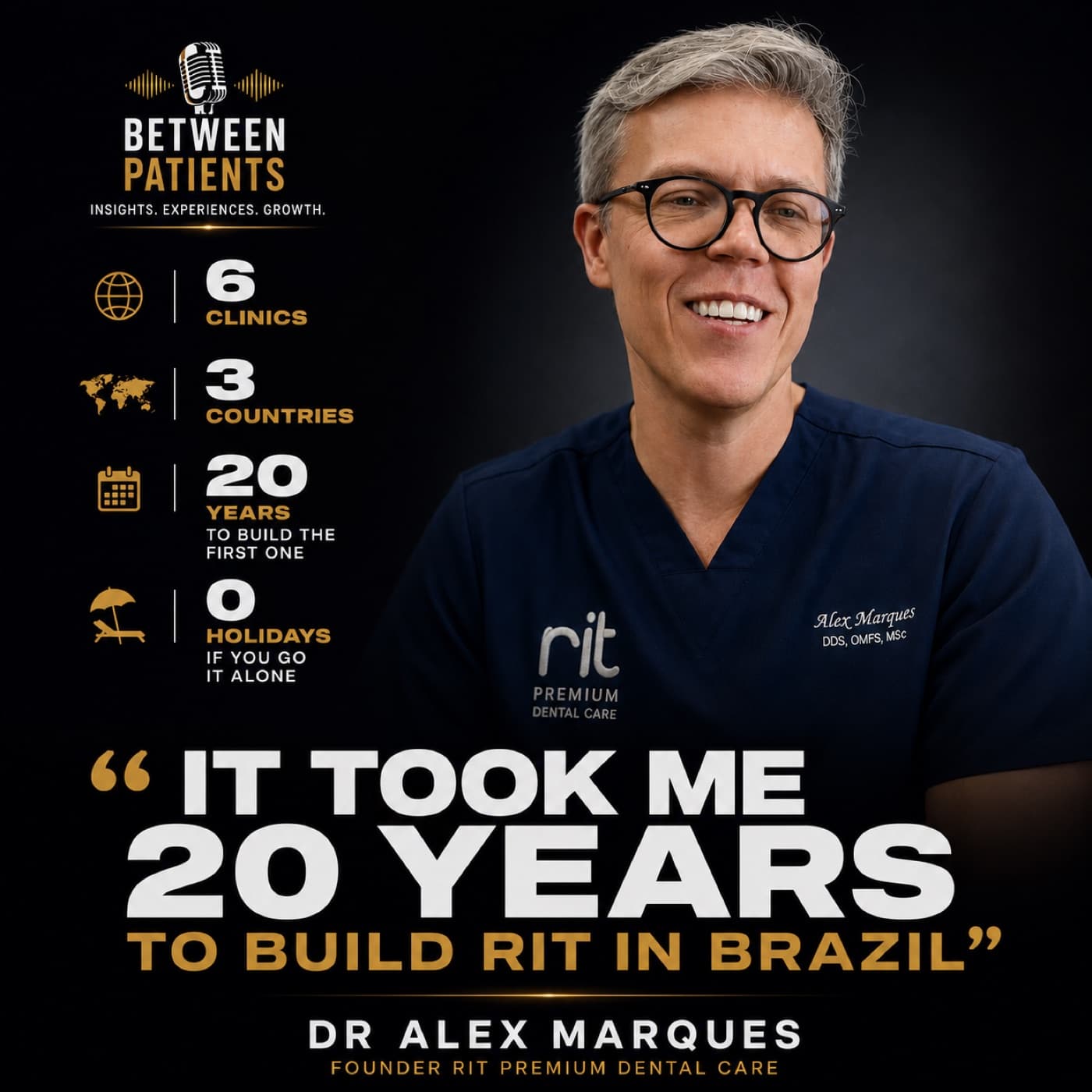

Most owners think the hard part of growth is the property, the fit-out or the loan. Dr Alex Marques has opened six practices across Rio de Janeiro, Lisbon, London, Liverpool, Birmingham and Chesham, and he will tell you none of those were the real bottleneck. The decision that made the difference was who he chose to build with.
He does not soften it. Choosing a business partner, he says, is like choosing a spouse. Get the right one and life is easier. Get the wrong one and it is a very difficult journey. It is a partnership you live inside every day, through good years and bad, and the wrong fit does not politely resolve itself. It just makes everything harder for a long time.
Alex reaches for a Warren Buffett story to make the point. Asked about the most important decision a person makes, Buffett did not talk about investments. He talked about choosing your life partner carefully, because that is the choice that shapes everything downstream. Alex applies exactly the same weight to a business partner. It is not a hire. It is the person whose values and judgement will be braided into yours for years.
Multiply leadership, do not just expand
This is where his approach to growth diverges from the usual playbook. Plenty of owners scale by adding sites and stretching themselves thinner across all of them. Alex scaled by multiplying leadership instead. At RIT, the associates who shared his values, brought real skill and genuinely cared about the work became partners and directors. They did not just fill rooms. They carried the culture into every new location, so the practice could grow without diluting into something Alex no longer recognised.
That is why he is honest that there is a ceiling. Culture gets genuinely hard to hold past a hundred or two hundred practices, and he has no interest in growing faster than the culture can travel. The instruction is to grow at the right pace, not the fastest one. Scale that outruns your ability to keep the culture intact is not an achievement. It is a problem you are building for later.
His sharpest line on all of this reframes what scaling even is. The biggest challenge, he says, is not opening another clinic. It is preparing the people who will lead it. Anyone with capital can sign a lease. Very few owners can develop leaders they trust to run a site the way they would run it themselves. That, not property, is the constraint on real growth.
Advice for the second location
So what does he tell an owner about to open their second site? Find a reliable business partner. The alternative is going solo, and Alex is candid about what that actually costs. Without the right partner you need an exceptional management team, and even then you never fully switch off. The phone never stops. The holidays are few. You become the single point of failure for two businesses instead of one, which is not freedom, it is a heavier version of the same trap.
The right partner changes that maths entirely. Responsibility is shared rather than shouldered alone. Ownership is spread across people who care as much as you do. The culture has more than one guardian. Growth stops depending on how much of yourself you are willing to burn, and starts depending on how well you chose the people beside you.
That is the thread running through everything Alex has built. Practices did not multiply because he worked harder than everyone else. They multiplied because he treated the choice of who to build with as the most important decision he would make, and then spent years preparing those people to lead. Get that right and the clinics almost open themselves. Get it wrong and no amount of ambition saves you.
Alex tells the full story of the partnerships behind RIT in the full episode of Between Patients. You can watch the whole conversation on YouTube.

Host, Between Patients
Host of Between Patients and the fourth generation in a dental family. I sit down with private practice owners for the conversation we usually only have once the door is closed — no script, full editorial control, a real record of how they think, decide, and rebuild.