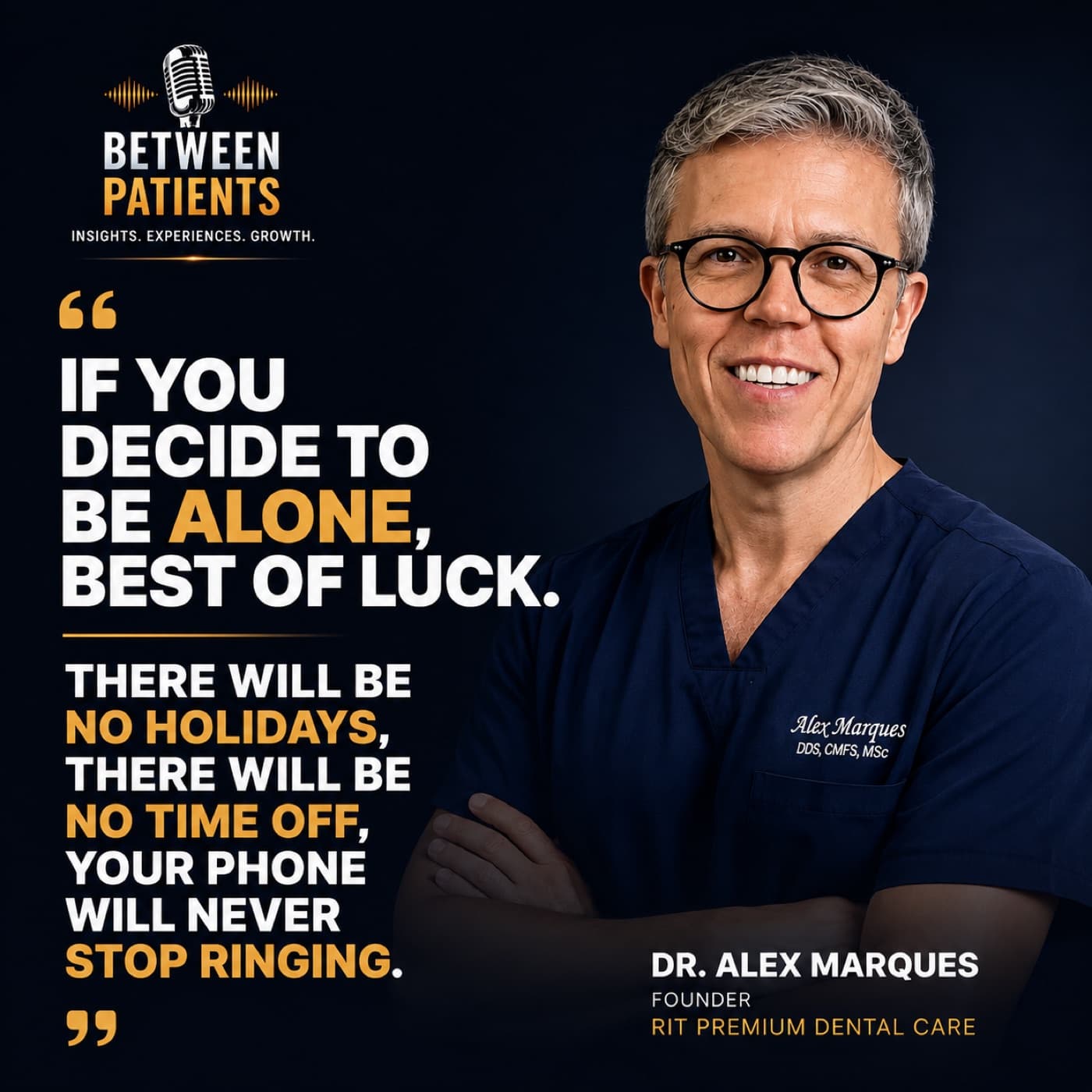

There is a quiet pressure in dentistry to be able to do it all. Root canals, implants, aligners, cosmetics, surgery. The profession trains the single operator who takes a patient from first appointment to final crown without ever passing them on. It feels like mastery. Dr Alex Marques thinks it is often the opposite, and he has a phrase for it: the lone hero problem.
Alex is an oral and maxillofacial surgeon with a PhD from King's College London, so he is not arguing from a lack of skill. His point is about how the skill gets used. Compare dentistry to medicine, he says, and the difference is obvious. Doctors work in multidisciplinary teams as a matter of course. No one expects a single physician to be the cardiologist, the radiologist and the surgeon in one body. Dentistry, by contrast, keeps rewarding the person who insists on doing everything alone.
The cost of that lands on the patient. When one clinician does every procedure, the treatment tends to get shaped around what that clinician can do, rather than what the patient actually needs. The plan quietly becomes procedure-centred instead of patient-centred. It is not dishonest. It is just the natural gravity of being a one-person show.
Assess the whole patient first
Alex runs it the other way round. He assesses the whole patient before anyone reaches for a handpiece, collecting comprehensive records so the full picture is on the table first. Only then does he bring in the right specialists for the job: the orthodontist, the endodontist, the periodontist, the cosmetic dentist. Sometimes, he points out, he is the last clinician involved rather than the first. The surgeon does not lead simply because he happens to be the surgeon. The patient's needs decide the running order.
That is exactly how RIT Premium Dental Care grew. It started as restorative work plus surgery, Alex alongside an orthodontist partner, and expanded by referral as they added an endodontist, a periodontist and a cosmetic dentist. They outgrew their premises. The first clinic now runs six surgeries. The growth was not one hero taking on more. It was a team assembling around the patient.
A bad product cannot be sold forever
None of this works without the fundamentals being right, and Alex is unsentimental about what those are. A beautiful practice, a warm reception, sharp marketing, clean branding and the latest technology all matter. He is not dismissing any of it. But he draws a hard line underneath them all: a bad product cannot be sold forever. If the dentistry itself is not excellent, patients notice, and no amount of polish covers for it.
That ordering is the whole philosophy in one move. Clinical excellence comes first. Everything else is built on top of it, not in place of it. A gorgeous waiting room attached to mediocre treatment is a countdown, not a business. Patients are far better judges of quality than the industry sometimes credits them for, and they vote with whether they come back.
Put the two ideas together and you get Alex's model of good dentistry. Build a team so no single ego shapes the treatment. Assess the whole person before you choose a procedure. Keep the clinical work genuinely excellent so the rest has something real to stand on. The lone hero looks impressive from the outside. The team quietly serves the patient better.
Alex goes deeper on the whole-patient approach, and how it shaped six practices across three countries, in the full episode of Between Patients. You can watch the full conversation on YouTube.
Host, Between Patients
Host of Between Patients and the fourth generation in a dental family. I sit down with private practice owners for the conversation we usually only have once the door is closed — no script, full editorial control, a real record of how they think, decide, and rebuild.