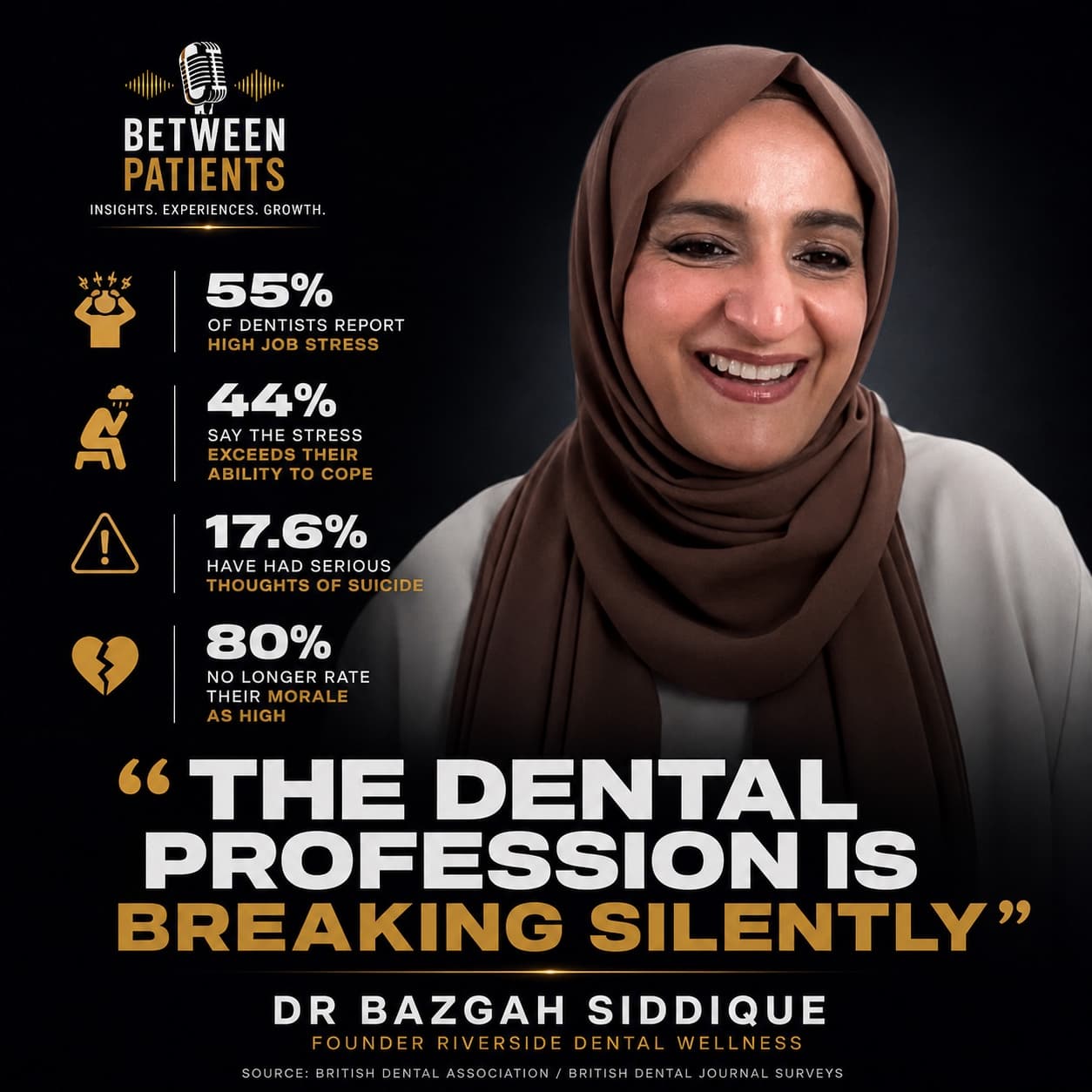

Some of the heaviest weight a dentist carries is a weight that was never theirs to pick up. Dr Bazgah Siddique named it directly on this episode of Between Patients:
You cannot control the biology of the patient. Why do we take the blame on ourselves?
It is a simple question and most dentists have never been asked it. Because the honest answer is that we were trained to.
Trained to own everything
Dental education rewards control. You learn to place a perfect margin, to get the occlusion exactly right, to leave nothing to chance. That standard is a good thing at the chair. The problem is that the same instinct does not switch off when the variable stops being controllable.
A patient does not floss. Another heals poorly because of diabetes nobody flagged. A third grinds a beautiful restoration to pieces under stress. Clinically, the dentist did everything right. Emotionally, the dentist still takes it home. The perfectionism that makes the dentistry excellent quietly rebrands every biological reality as a personal failure.
Do that five days a week for twenty years and it adds up. It is one of the invisible engines behind the survey figures: the stress that exceeds coping, the collapsed morale, the darkness at the bottom of that list.
The difference between responsibility and blame
There is a line worth drawing carefully here, because Bazgah is not arguing for carelessness. Responsibility is real. You are responsible for your standard of care, your consent process, your follow-up, your honesty. That is yours and it should be.
Blame is different. Blame is absorbing the outcome of factors you never controlled: a patient's genetics, their habits, their compliance, their body's response. You can do faultless work and still get a disappointing result, because biology gets a vote and you do not chair the meeting.
Confusing the two is the trap. When you take responsibility for your process and blame for every outcome, you have signed up for a job no human can win.
Putting the blame down
The practical shift is small and surprisingly hard: judge yourself on the quality of your decisions, not the mood of the biology. Did you assess properly, consent honestly, treat to your standard, follow up? Then you did your job, whatever the tissue decided to do next.
That is not a licence to stop caring. It is permission to stop carrying what was never yours, which is the only way to keep caring for a whole career without it hollowing you out.
Hear the full conversation with Dr Bazgah Siddique on the episode page. If this is a conversation you could have honestly, on the record, apply to be a guest.

Host, Between Patients
Host of Between Patients and the fourth generation in a dental family. I sit down with private practice owners for the conversation we usually only have once the door is closed — no script, full editorial control, a real record of how they think, decide, and rebuild.