
This is the question at the heart of the whole argument, and it is the one people get most emotional about. If the next generation of implant dentists trains only on guides and navigation, who will be able to operate when the technology cannot?
Dr Jono Michael is well placed to answer it. He is an implant and reconstructive dentist in Sydney, he did his master's in oral implantology at Goethe University in Frankfurt, and robotic assistance was part of that training. On the full episode he refused to take the easy side of it.
I don't want to be the dinosaur in the room.
Dentistry has already lost skills, and mostly it did not matter
His first move is to widen the frame, because deskilling is not new.
He learned to place amalgam fillings on a plastic model. When it came to doing one on a real patient, his supervisor stepped in and did it. He went into private practice and never used amalgam again. A skill he never actually gained.
Impression materials are going the same way. A graduate qualifying now may only know digital scanners. Is there a case where impression material works and a scanner does not? Probably a few, and probably a workaround is coming.
Some would say it's not necessarily a skill lost, it's just something that was a past era.
So the honest position is that yes, technology deskills us, in a limited sense, constantly. Most of the time that is progress rather than loss.
Why surgery is not the same
Then he draws the line, and the reason is precise.
The amalgam case is a skill replaced by something better. Guided surgery is not that. Nobody is claiming a guide is a better way to handle a complication. The guide handles the position. It does nothing about the situation where the bone is softer than the scan promised, or bleeding obscures the field, or the case turns halfway through.
It isn't so much that there's something better now. It's more that, are we learning how to navigate the difficult situations if we rely on these guides?
That reframes the question in a way that is actually answerable. The problem is not the guide. The problem is a training pathway where complication management never gets learned, because the guide kept the trainee out of the situations that teach it.
His test is a single conditional, and it is worth committing to memory.
If those skills are learnt first, then there isn't really a loss of skill.
Learn to handle trouble, then add the technology, and nothing is lost. Add the technology instead of learning to handle trouble, and something important is gone.
The learning curve you flatten by being careful
There is a genuinely uncomfortable idea here for anyone starting out.
A beginner worried about hitting something reaches for a guide to reduce the risk. That instinct is sensible and the risk is real. But it has a cost that does not appear until years later.
Unfortunately, you really flatten out your learning curve in learning how it is to place an implant, what the bone feels like.
Drilling through a guide, you are less able to read the bone you are drilling into, and less able to modify what you are doing in response. The predictability goes up while the learning goes down. Jono can drill through a guide and still tell what is happening under it, because he has placed thousands of implants. A dentist who has placed thirty cannot, and the guide is part of why.
His recommended path is the reverse of the marketing:
- Surgical principles first, one hundred percent, before anything else.
- Then freehand placement, ideally with someone more experienced watching over your shoulder.
- After roughly twenty, thirty, maybe fifty implants, introduce static guides.
- Only after several hundred implants look at dynamic navigation and robotics.
The logic is that complexity multiplies failure modes. The more the outcome depends on a machine, the more you need the experience to recover when the machine is wrong.
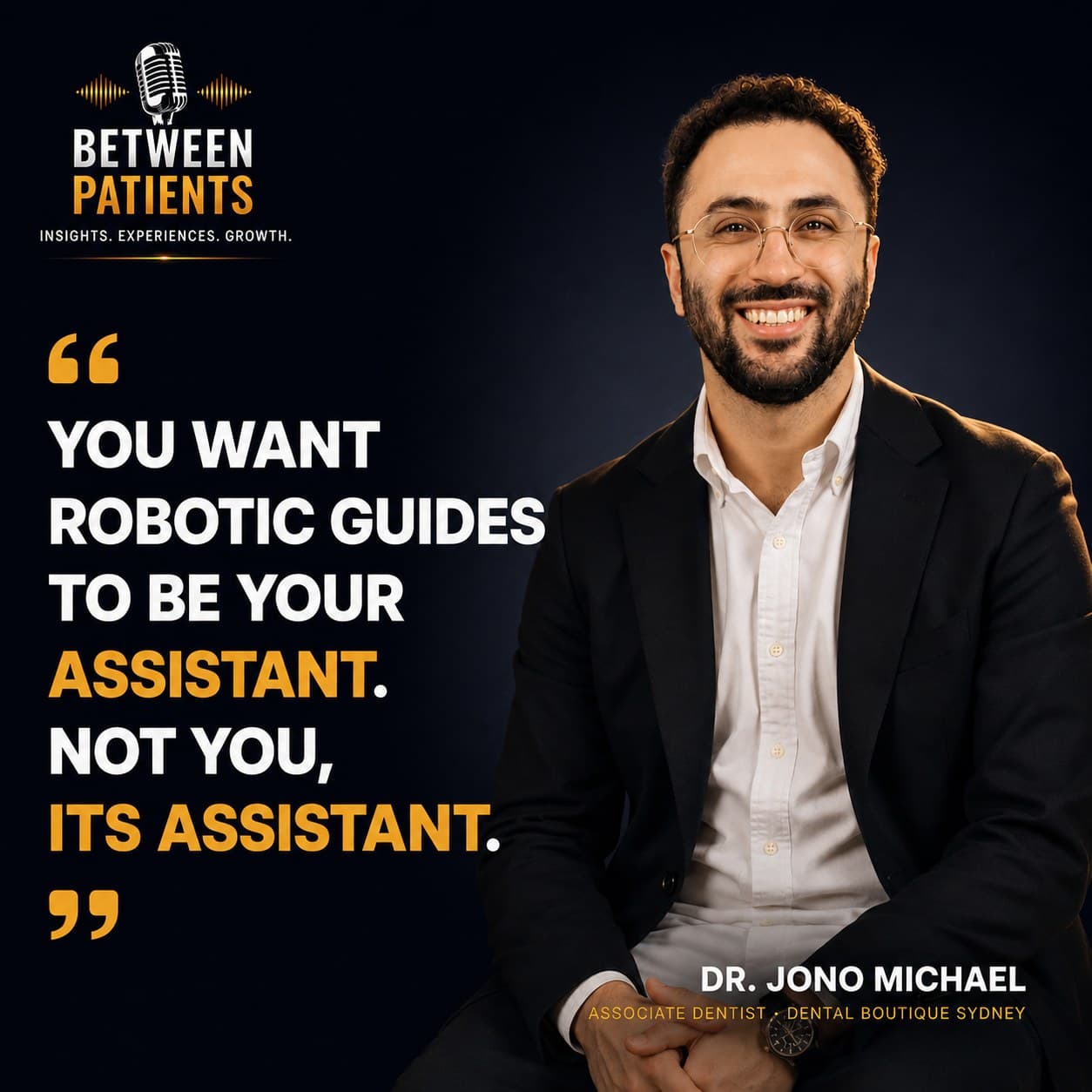
You want it to be your assistant, not you, its assistant.
The aviation comparison, and the one thing that would change his answer
Pilots fly on autopilot and the industry worries they can no longer hand fly. Is dentistry walking into the same problem?
His answer depends entirely on one variable: whether guidance stays optional.
As an accessory, it helps. If the profession ever mandates it, if you must place every implant with a static, dynamic or robotic guide, then the skill genuinely goes.
What is striking is that he does not treat that outcome as automatically bad. If the complication data ever showed that freehand placement was harming patients at scale, he would expect a regulator to step in, and he would accept the consequence.
Unfortunately, yes, some people will then lose that skill, but at the end of the day, if the outcome is better for the patient, that's really what we're here to do.
That is a more serious position than either camp usually takes. It also comes with a warning about where the complication data may be heading. Implants used to be placed by a small number of specialists with extensive training. As the door opened to general practice, volumes rose, and in his view failures and complications are rising with them. The interesting question for the next decade is whether robotics ends up cleaning up a problem that easier access to implantology helped create.
The practical answer
Nobody has to choose a side. The order is the whole thing.
Learn surgical principles. Place implants freehand with supervision until you can read bone through a handpiece. Then add a guide, and let it make a competent surgeon more predictable rather than let it stand in for competence you never built.
Listen to the full conversation with Dr Jono Michael, and see what the technology actually costs before you buy any of it. The $2 Dentist makes the same argument about money that he makes about skill.

Host, Between Patients
Host of Between Patients and the fourth generation in a dental family. I sit down with private practice owners for the conversation we usually only have once the door is closed — no script, full editorial control, a real record of how they think, decide, and rebuild.