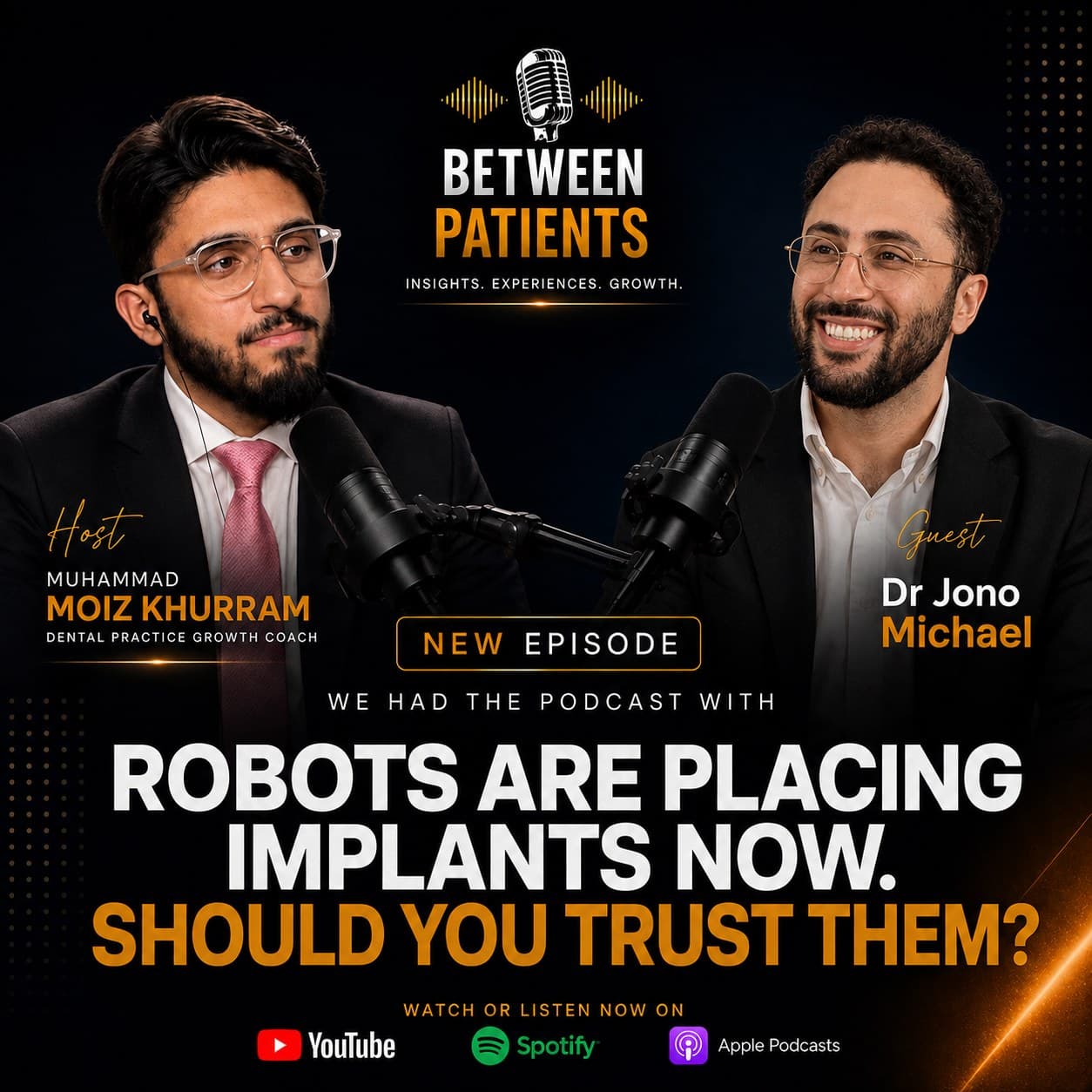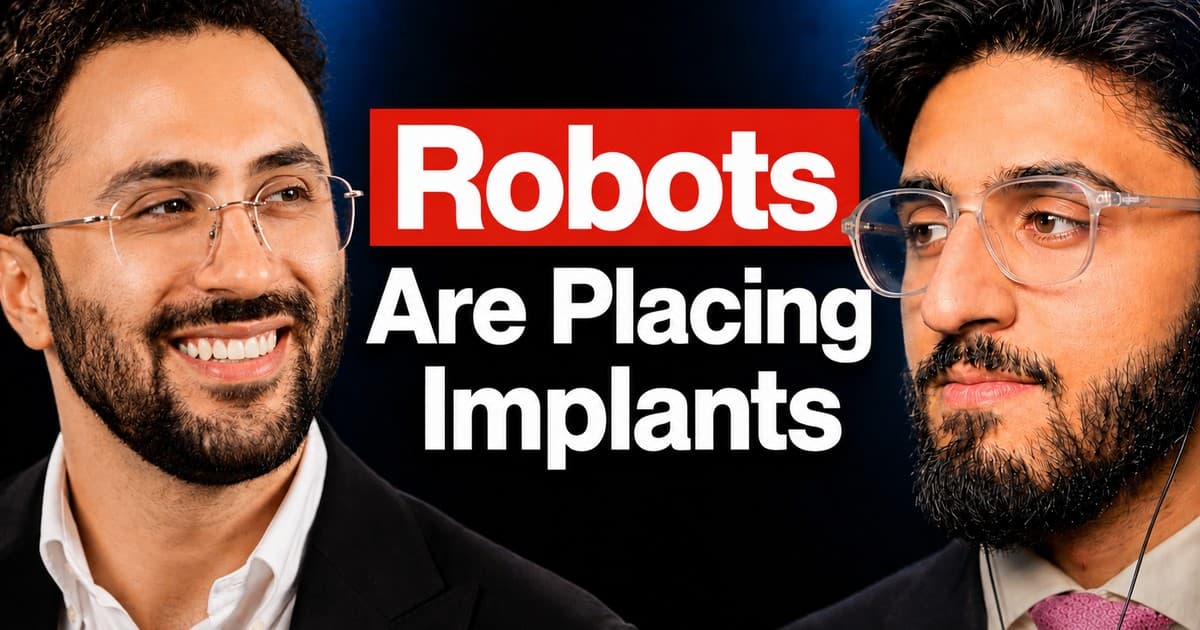

Most arguments about guided implant surgery fall apart because the two people arguing are not talking about the same thing. One means a printed piece of plastic. The other means a robotic arm. They are not the same technology, they do not carry the same risk, and they do not cost within two orders of magnitude of each other.
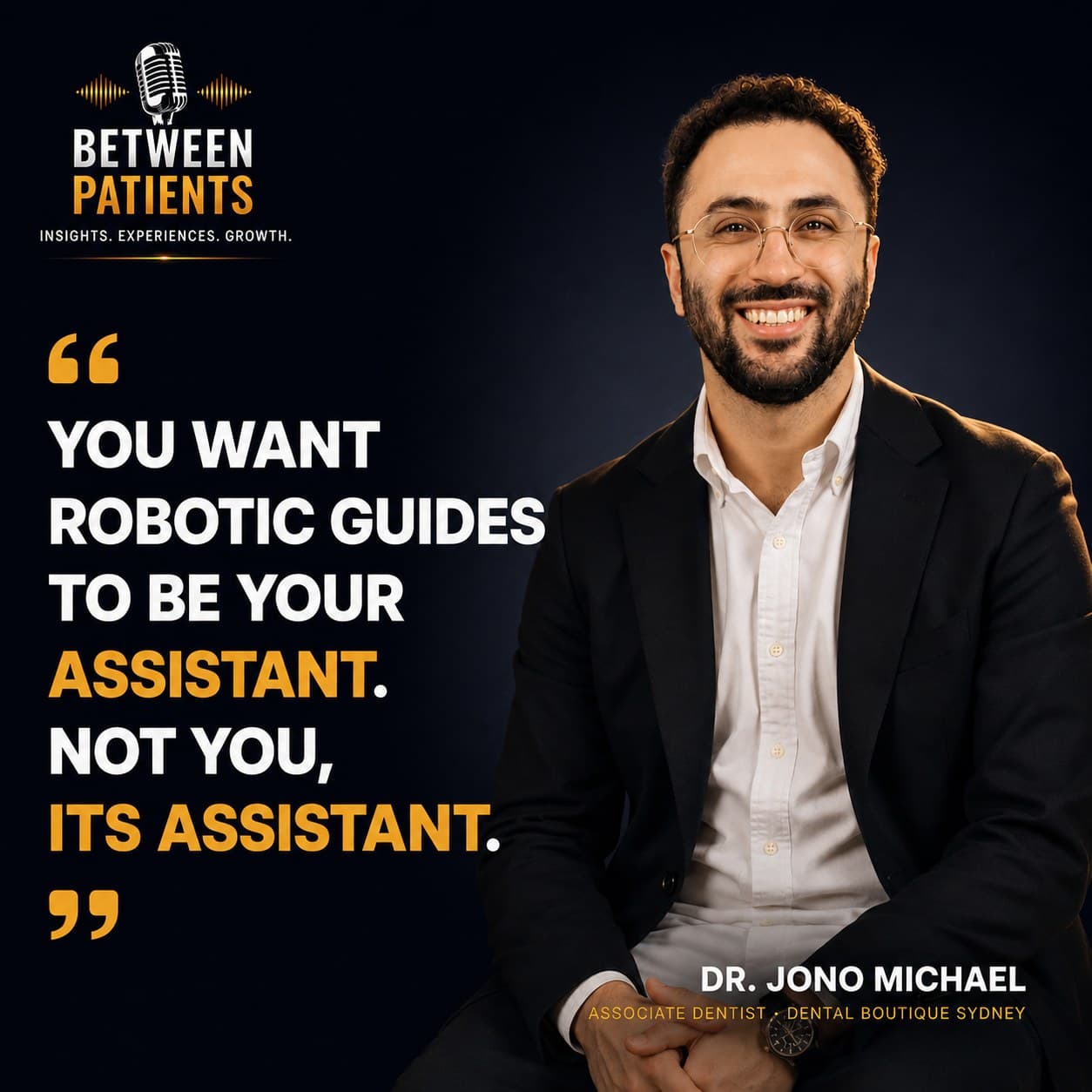
Dr Jono Michael is an implant and reconstructive dentist in Sydney. He did his master's in oral implantology at Goethe University in Frankfurt, he uses static guides every week, and robotic assistance was part of his training. On the full episode he laid out the ladder properly, so here it is.
Level one: freehand
No guide. The plan lives in the surgeon's head and the drill goes where their hands take it.
Jono calls this brain guided, and he is not being dismissive. More than half of his own implant work is still done this way. The advantage is total freedom to change course. The disadvantage is that everything rests on the operator, and as he puts it, every surgeon is going to be quite different.
Level two: the static guide
This is the one most dentists mean when they say guided. A 3D printed sleeve, planned on software beforehand, that physically constrains the drill to a pre-decided path.
It's a piece of plastic really that's 3D printed with a hole in it.
What it changes on the day is predictability. If you are working in a narrow gap between two teeth and you are not certain whether you are one millimetre left or one millimetre right, the guide holds the position you planned. It stops local anatomy pulling you off course.
There is a catch he is honest about. A guide can add complexity before it removes any. The guide has to fit, and occasionally it does not. Once you have confirmed the fit, the workflow simplifies. Before that, you have added a step that can fail.
The deeper argument for static guides is not about the drill at all. It is about the tooth.
Implant surgery is all about the tooth. It is a prosthetically driven discipline rather than a surgically driven discipline.
Planning a guide forces you to decide where the final tooth or bridge needs to sit, then reverse engineer the implant position to serve it. That happens at a desk, days before anyone is in the chair, which is the whole point.
Level three: dynamic navigation
The plan is made the same way, but instead of a plastic sleeve you get a live feed. The handpiece is tracked, and a screen shows you where your drill actually is against where your plan said it should be. Deviating is allowed. You simply see it happening and can adjust, which is where the name comes from.
Jono has not used it, and his reason is worth hearing because it is not the reason you would guess. The access is there now if he asked for it. Earlier in his career it was instinct, not access. He was not ready to add another variable to a surgery where he already had a long list of things to think about.
His current objection is colder. When you compare the literature on dynamic against static, the accuracy difference is not large. The cost difference is.
I'm not sure the argument's quite there yet for the dynamic systems.
He suspects dynamic navigation was a stepping stone for engineers rather than a destination for clinicians.
Level four: robotic assistance
The robot holds the handpiece. Cameras and sensors placed around the room track the arm, and the system resists any movement that contradicts the plan you made beforehand. You can override it with enough force, and it will release control. Move delicately and it holds you to the plan.
Two things surprise people. The robot does not plan for you, and it is not autonomous. You still do the planning, and your hand is still on the handpiece. Yomi was cleared by the FDA in 2017, so this has been in real patients for close to a decade.
What it genuinely adds, in Jono's view, is a second pair of eyes.
It sort of can catch a mistake before it happens.
When the robot refuses to continue, that refusal is information. Something in the plan and something in the mouth disagree, and you get a moment to work out which one is wrong before damage is done. He described it as a nudge over the shoulder.
The accuracy numbers, and why they settle less than you would hope
Across the trials and meta-analyses Jono has read, guided placement lands roughly one to one point two millimetres from the planned entry point, and around one point four millimetres out at the tip. He is careful about those figures.
You can't sort of rely on them being the be all and end all.
A millimetre sounds like nothing until it is the millimetre between you and a nerve, or an adjacent root. And an average hides the shape of the distribution. A system can be extremely accurate in one case and wildly inaccurate in another and still post a respectable mean.
Most of these studies also run on models rather than people. No bleeding, no patient shifting in the chair, no soft bone where the scan promised dense bone. As he points out, the same site on the left and the right of one patient are already two different situations.
Where that leaves you
The ladder is real, and so is the order of it. Guidance is an adjunct that gets more useful the more skill sits behind it, and more dangerous the less. That is the argument he makes for placing your first implants freehand, which we cover in why he still places most implants freehand, and the reason the deskilling question refuses to go away.
Listen to the full conversation with Dr Jono Michael. If you are working out where technology should sit in a growing practice, The $2 Dentist is about spending on the things that actually change outcomes.

Host, Between Patients
Host of Between Patients and the fourth generation in a dental family. I sit down with private practice owners for the conversation we usually only have once the door is closed — no script, full editorial control, a real record of how they think, decide, and rebuild.