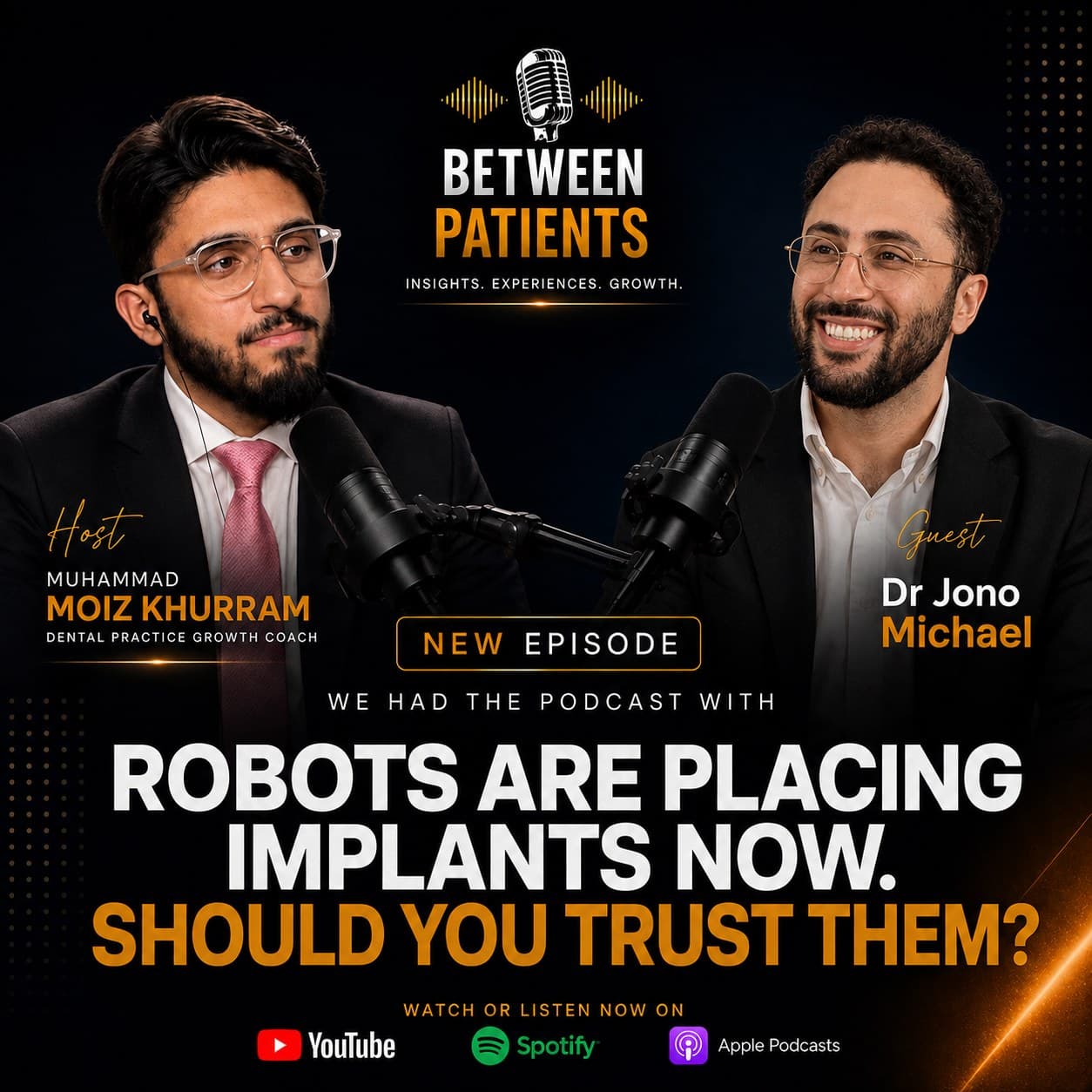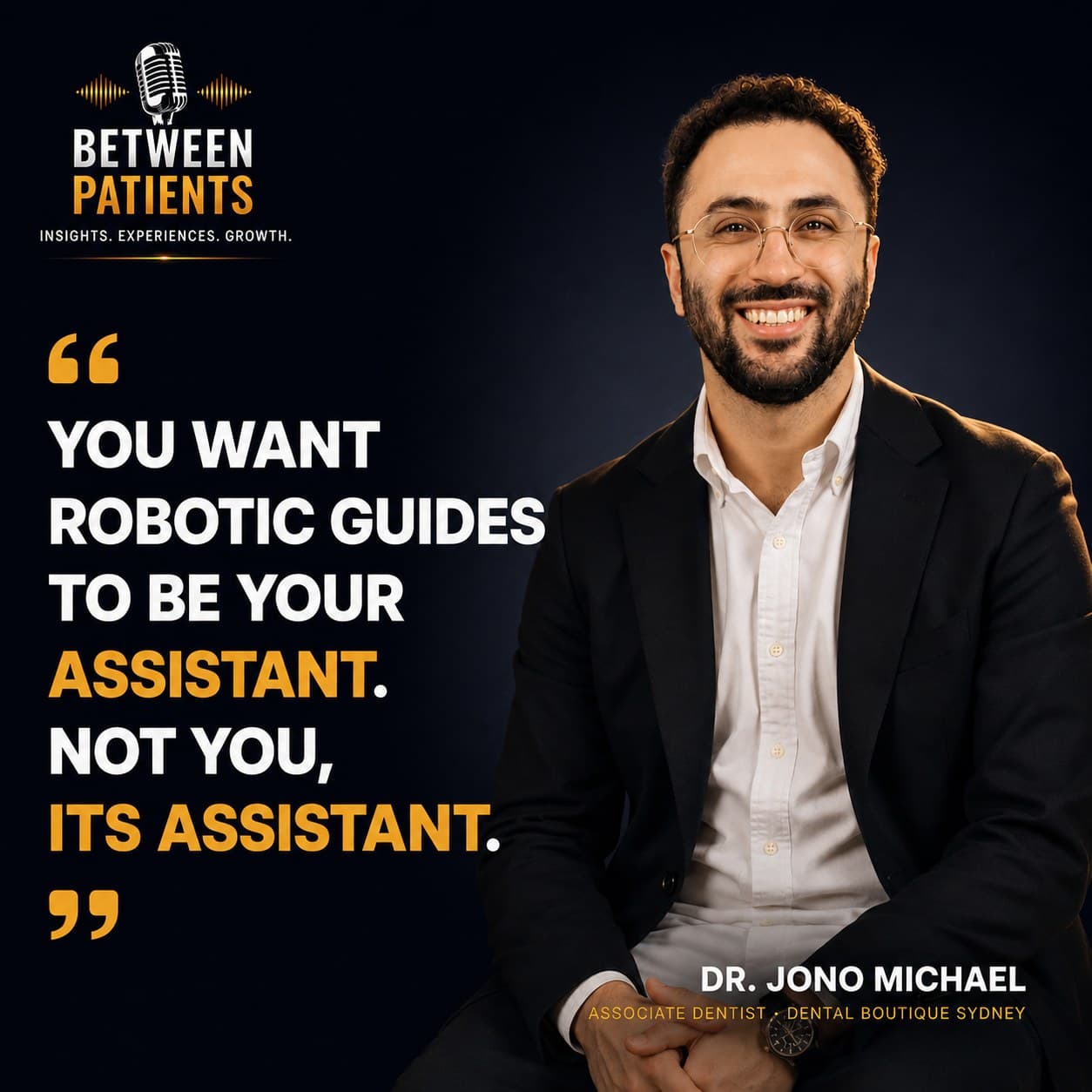

Ask a dentist who has trained on robotic implant guidance which method he reaches for, and you expect the answer to be the expensive one. Dr Jono Michael did his master's in oral implantology at Goethe University in Frankfurt, studied robotic assistance as part of that training, and uses static guides in his Sydney practice every week.
More than half of his implant work is still freehand.
That is not nostalgia. On the full episode he gave a specific clinical reason, and it comes down to a distinction that gets lost whenever accuracy is the only thing being measured.
An implant in the right place can still be a failure
A guide is built to control position. Position is not the only thing that decides whether an implant works.
The other thing is primary stability, and a guide cannot give it to you. Bone quality does not always match what the scan suggested.
Sometimes it seems really stable on an X ray and it seems like the bone is going to be very dense, but occasionally these metrics are a bit off and the bone might end up being a lot softer.
Jono has had cases where he expected miles of stability and met soft bone instead. Working freehand, he moved. Left a little, right a little, adjusted the plan mid surgery without creating a problem for the patient. Working strictly to a guide, that adjustment is the thing you have designed out.
His summary of the trade is blunt.
Of course it's in the right place maybe, but if it's not stable it's no good to anyone.
Where this matters most: full arch
A large part of his practice is full arch reconstruction. All on four, all on six, all on X, whichever name you use. No teeth left, everything rebuilt.
Two things make guides difficult here. The first is that the bone rarely presents where the tooth root used to be, so angle corrections are constant and the teeth do not sit directly over the implants anyway. There is more positional flexibility than people assume, which weakens the case for constraining yourself.
The second is cumulative error, and this is the part worth understanding properly.
A full arch guide has to be supported by something. If it is bone supported, the guide's own position depends on the first set of positioning pins. Get those slightly wrong and every implant that follows inherits the error.
If it's not a hundred percent, then all of your implants are going to be off.
The alternative approach is staged. Place some implants using the remaining teeth for support, remove the teeth, then rely on those first implants to support the next guide. That only moves the problem. If the first few are not ideal, the next few are skewed too.
Then there is timing. For the full arch cases he does, teeth go in the day after surgery. That makes stability non negotiable in a way it simply is not for a single implant, where you can close the gum, wait a few months, and everything is fine.
With full arch, we really need those implants to be stable. And if we follow the guide and the implants are not stable, we're running into a bit of a problem.
He is careful to say there are excellent clinicians getting very accurate full arch outcomes with guides. For the style of full arch he does, freehand gives him the freedom to chase the stability he needs.
Where he does use a guide
None of this is an argument against static guides. He uses them, and he is clear about what they buy.
For single implants and cases with adjacent teeth still present, a guide holds a position that anatomy would otherwise pull you off. In a narrow gap, one millimetre left versus one millimetre right is the difference between a clean result and a damaged root. That is exactly the situation a guide is built for.
It also lets him decide the prosthetic outcome before the surgery rather than during it. Reverse engineer from where the tooth has to end up, then place the implant to serve it. The planning happens at a desk, days early, when there is time to think.
And on a simple case it is quick. If the drilling feels right, the implant can go through the guide in five minutes or less.
The judgement is the skill
The pattern across everything he said is that the decision sits above the technology, not inside it. Single unit with teeth either side, guide. Full arch where stability decides whether the patient eats tomorrow, hands.
That judgement is only available if you have drilled enough bone to know what soft feels like through a handpiece. Which is the awkward part, because a guide is very good at hiding exactly that information from whoever is holding the drill.
It can make it more difficult to get a good feel of what you're doing if you are just relying on the guide without having a prior history of a lot of experience.
That is the thread we pull on in the deskilling question, and it is the reason his advice to anyone starting out runs in the opposite direction to the marketing.
Listen to the full conversation with Dr Jono Michael. For more on building a practice around judgement rather than kit, The $2 Dentist is the short version.

Host, Between Patients
Host of Between Patients and the fourth generation in a dental family. I sit down with private practice owners for the conversation we usually only have once the door is closed — no script, full editorial control, a real record of how they think, decide, and rebuild.